Australia is not short of infrastructure projects. It is short of certainty about what gets handed over at the end of them.
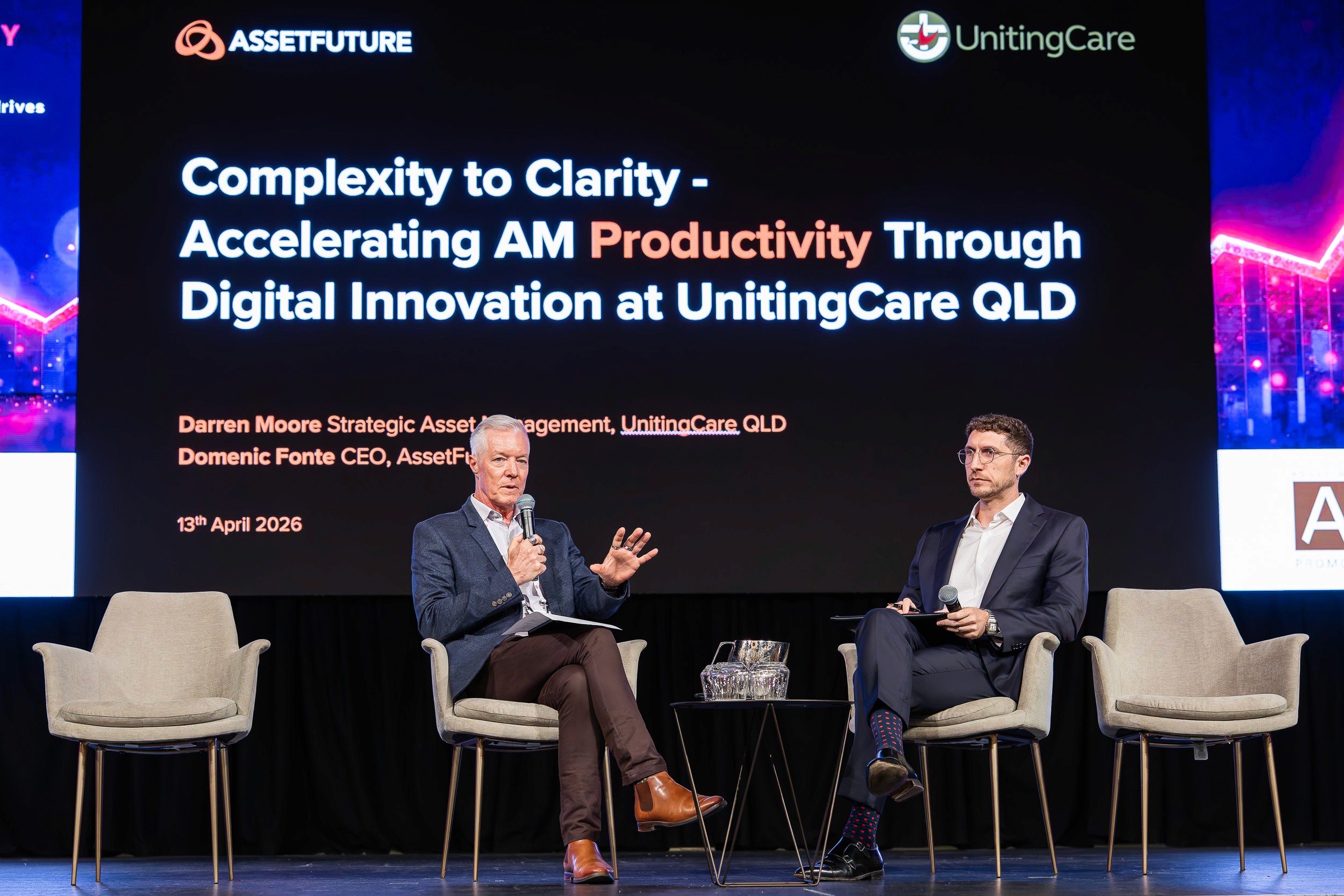
That was the thread running through the panel at Cupix Experience Sydney on 3 September, where AssetFuture's Domenic Fonte joined Amber Haddock and Brendan Smith to discuss whether the industry has the capability and systems to deliver increasingly complex infrastructure well.
The framing was sharp. According to the 2026 Hubexo Construction League, Australia's top 50 builders started 722 projects worth $43.9 billion, a 32 per cent increase on the previous year's $33.1 billion, from roughly the same number of starts. The market is not simply busier. Projects are getting larger and more technically demanding.
Dom's contribution came from the other end of the lifecycle.
The problem is not a shortage of data
Asked what holds back productivity in Australian construction and infrastructure, Dom pointed to the moment immediately after construction finishes.
"The biggest single thing holding back productivity is the handover and translation of as-built plans and data into operational registers and intelligence. I like to refer to this as data continuity."
The foundation of asset management for an operating facility is data. Where the information handed over does not reflect what was actually built, the owner is left with two options. Invest in getting the foundations right, or pay for it indefinitely through inefficiency and reliance on facilities managers.
In Dom's experience, the second option is more common than the first. Often because the owner does not value the information at handover, or does not know what to do with it once they have it.
The gap opens at commissioning, then keeps opening
Commissioning is where the panel agreed the first gap appears, for exactly that reason. The data is available but nobody owns it.
The second gap is less discussed and, in Dom's view, more damaging. Asset records deteriorate across the operating life of a building. Every time a facilities management or asset management provider changes, there is often little to no handover of data between the outgoing and incoming provider, and the historical record is lost.
He was direct about why it persists. Owners rely on third parties to hold that information, and it is not in the third party's interest to hand it over.
Data currency: keeping the record true for 20 years
If the construction record is accurate at handover but the asset then changes for the next 10 to 20 years, what stops it becoming obsolete?
Dom's answer was a term AssetFuture has started using deliberately.
"We've coined a term, data currency, which is where asset information, including plans, space registers and asset registers, are kept up to date via a data management process."
That requires the right people, processes and solutions in place so records are updated whenever capital or maintenance works are carried out. The heavy lifting should be done by technology. The part that trips organisations up is usually cultural, not technical.
What he would want earliest
The panel closed by asking each speaker for the one piece of trusted information they would want available earlier than they get it today.
Dom's answer was an accurate asset register. It is what enables planning, procurement, contractor engagement and capital works, and it is the thing most owners discover they do not really have.
Thanks to Cupix for hosting, and to Amber Haddock and Brendan Smith for a genuinely useful conversation.